Sunday, 22 November 2015


"'Eavedrip' Graves and the Treatment of Infant Burials in Early Christian England" 


Seminar by Dr Elizabeth Craig-Atkins


Report by Claire Hyland

The lecture given by Dr. Elizabeth Craig-Atkins from the University of Sheffield was on the topic of infant burial customs in Early Christian England and how the Eave-Drip graves of infants may have been considered a form of posthumous baptism in a world of high infant mortality. Throughout Early Christian England, centered on the 7th-12th centuries, infant burials were often found clustered around the walls of churches. It has been suggested that by placing the infant burials near to the eaves of churches, it was hoped that the rain water that flowed down the roof would be sanctified by its contact with the church and would drench the infant burials in posthumous baptism, thereby ensuring a guaranteed place in heaven for the very young who perished early in life. Such burials usually revolve around infants under 1 year and who were stillborn or died soon after birth.
Throughout the lecture, Dr. Craig-Atkins stressed the importance of viewing the Eave-Drip in its proper historical context in order to fully understand how and why such burial sites were utilised especially for infants. She stated that studies of childhood in archaeology have the potential to focus on explorations of the life course of an early medieval child and its significance. Despite the evidence that very young children were treated differently in funerary customs, the topic has not received enough archaeological attention. In the early medieval period, infants were often buried in unusual locations and burial forms. The Dorchester Roman town house (4th-5th A.D.) is such an example. In osteological data, assessment of age at death is very accurate (the exception being stillborns or those who died shortly after birth) although telling the gender of an infant is incredibly difficult to determine without the use of DNA. Such assertions are based on dental data, epiphyseal fusion and bone length.

In Raunds Furnell’s hypothesis on the treatment of infant burials in early medieval England, he discovered that children under two years were often buried close to the church and that such a practise originated in the 11th century. He referred to such burials as ‘Eave-Drip Graves’ and noted that the infant burials were clustered around 1.5m within the church walls and that most were under a year old with Hereford, Pontefract and Spofforth being examples. However, the theory of eave-drip burials has received criticism. Recovery bias such as the failure to properly identify juvenile bones and a lack of a satisfactory explanation behind spatial patterning has been cited as to elucidate non-ritual explanations for the phenomenon of eave-drip burials. Taphonomy, which states that infants are often buried in smaller, shallower graves than adults and that selective preservation will often leave only certain remains behind, is suggested as an alternative to eave-drip graves. However these factors, as Dr. Craig-Atkins notes, only take into consideration preservation which does not create eaves-drips patterns. Demographic factors, such as peaks in infant mortality and there being few examples of multiple eaves-drip burials, may explain their quantity but not their unusual location in the early medieval churchyards.

Eaves-drip burials are seen as a further reinforcement of the baptism ritual and to ensure that the unlucky infants receive a place in heaven. Although early Christian writers are extremely poor at documenting funerary rites and the relevance of baptism was questioned at times, baptism was important enough for the county of Wessex in 640 A.D to pass a law insisting that all infants over 30 days be baptised. Regarding infant burials there seems to be a broad cultural distinction between infants and older children especially in regards to speech and independence. Rites of passage associated with children seem to have been the advent of speech, limited independence and the cessation of breastfeeding all of which occur around the age of two. Were children who passed the age of two therefore considered to be more valuable in terms of how they were buried? Is there a connection between the onset of speech in children and the alteration in funerary patterns? Were eave-drip burials reflections of an early Christian community attempting to echo negative connotations on the deaths of very young children? All in all, the subject of infant burials in early medieval England is fascinating, engaging and justly deserves more research and analysis with regard to its archaeological value.


Sunday, 1 November 2015


UCD Archaeology Society International Trip Information


Prague 10th – 15th January

Research done to accommodate a group of 28 people for 6 day/5 night period
For further information or to book a place contact
archaeology.soc@gmail.com


€20 deposit is required when booking a place.


Flights:


*Flights to be booked and paid for by each individual person*

  • Dublin to Prague: FR7326
  • Departing Dublin at 13:40 - Arriving in Prague at 17:05
  • Prague to Dublin: FR7327
  • Departing Prague at 17:30 - Arriving in Dublin at 19:10
  • Cost without check in baggage: €67.98
  • *Flight prices will vary slightly depending on when they are booked. The
  • sooner they are booked, the cheaper they will be*
  • Source of information: ryanair.com
  • Also the option of flying with Aer Lingus for €98 at roughly the same time.
  • Check Aer Lingus for details.


Public Transport:


  • No Metro to/from the airport, service only by bus.
  • Metro runs on 3 different lines (map below) from 4:45
  • am to 12:00am at 1 -3 minute intervals. 

Useful Metro Vocab:

  • eskalátor - escalator
  • linka (A, B, C) - line (A, B, C)
  • metro - subway
  • estup - transfer
  • stanice metra - subway station
  • trasa - route
  • vstup - entrance
  • výstup - exit

Cost: Single 30 minute journey ticket: 24 CZK/ €0.90 – cost of public transport will be covered in the tourist card.


Accommodation: Fusion Hotel:


 Located:


  • 50m to the Wenceslaw Square
  • 50m from Můstek metro, line A,B,
  • 30m to the nearest tram stop
  • 850m to the Old Town Square
  • 450m to the Main Railway Station
  • 10km to the airport.
  • From the airport:
  • The bus costs cca 60 CZK and it takes
  • total cca 30-40 min to get to the hotel.
  • Bus AE to main station

Facilities:

  • 4 person Flexi Room ensuite (7 rooms) –
  • Single Beds
  • Breakfast included.
  • Private bar and club
  • Restaurant
  • Ensuite bedrooms
  • Free wifi

Cost: €125 per person for the 5 night stay
100% of the payment to be paid 3 weeks before arrival
For more information: http://fusionhotels.com/


Prague Tourist Card:


  • A sightseeing pass
  • Visit a number of sites including: Prague Castle, world-class Jewish Museum, Old Townhall and Petřín Tower etc
  • Entry to 50 different attractions free of charge
  • Discounts to 30+ more attractions, restaurants, pubs, etc.
  • In addition gives you unlimited access to the City Public Transport
  • Saves up to €60 per person

Cost for 4 day card:


  • €47 student up to the age of 26
  • €65 adult
  • Can be purchased at the airport


Other:


  • Weather: expected to be between 1 and minus 1 degrees on average so please do bring warm clothes and waterproof walking shoes as snow is expected
  • Money: Czech Republic don't use Euro but use Krona. Exchange rate is roughly €1 = 330 czk
  • Can be exchanged over there at a special rate with the tourist card, however I would recommend exchanging money before we depart.
  • If you plan to use your bank cards, check that there's no bank charges.


Provisional Agenda


Day 1: 10th January 2016: Arrival day
.

  1. 13:40: Depart Dublin Terminal 1
  2. 17:05: Arrive in Prague Airport
  3. 17:20: Gather group in arrivals and head to hotel
  4. Check into hotel and allocate rooms.
  5. Evening Free

Day 2: 11th January 2016.

  1. 10:00: Meeting in Hotel Lobby
  2. 10:45: Historical Prague Bus Tour
  3. 2 hour bus tour taking in the sites of Old and New Town Prague. Picks up and drops of in Old Town Square.
  4. 12:45: Break for Lunch
  5. 14:00: Prague Castle Tour B: Circuit B includes Old Royal Palace, St. George’s Basilica, The Golden Lane, The Powder Tower, St. Vitus Cathedral, St. Wenceslas Cathedral. Closes at 16:00 during the Winter
  6. 16:00: Return to Hotel
  7. Evening Free

Day 3: 12th January 2016.

  1. 9:00: Meeting in Hotel Lobby
  2. 9:30: Old Tower Hall and Tower, Astronomical Clock and Tower
  3. 11:30: Jewish Museum and Synagogue
  4. 12:30: Break for Lunch
  5. 13:00: Kinsky Palace and St. Agnes Convent
  6. 15:00: Panoramic boat cruise 
  7. Evening Free.

Day 4: 13th January 2016.

  1. 10:00: Meeting in Hotel Lobby
  2. 10:30: National Museum and Prague City Museum
  3. 13:00: Break for Lunch
  4. 14:00: Troja Chateau and Veletrzni Palace
  5. 16:00: Head back to Hotel
  6. Evening Free

Day 5: 14th January 2016.

  1. Day Trip to Tábor
  2. Times to be confirmed

Day 6: 15th January 2016: Departure Day

  1. 10:30: Check out of hotel
  2. Afternoon free
  3. 14:00: Regroup at hotel and head to airport
  4. 17:30: Fly out of Prague Airport
  5. 19:10: Arrive in Dublin T1
  6. And then you’re free.

Breakdown of costs per person (before subsidized):


  • Flights (to be booked individually: €68
  • Hotel for 5 nights: €125
  • Prague tourist card: €47
  • Total: €240
  • I’ve applied for a grant and hope knock this down to €160 - 180 all inclusive.

Please keep an eye on the emails for updates. Any questions please do
contact archaeology.soc@gmail.com or catriona.baldwin@ucdconnect.ie
Any questions please don’t hesitate to ask. I’d be happy to help.
All the best,
Catríona.
(Auditor).

Tuesday, 27 October 2015


"The Amesbury archer- Migration and Knowledge in the Copper Age"


Seminar by Dr Andrew Fitzpatrick


Report by  Emily Glynn-Farrell


On the 15th of October 2015 the society Welcomed Dr. Andrew Fitzpatrick of the University of Leicester for a seminar on 'The Amesbury Archer-Migration and Knowledge in the Copper Age'. This seminar discussed the discovery of the Amesbury archer near Stonehenge in Wessex, the movement of Bell-beaker people throughout Europe and the characteristics of their material culture.
Dr. Fitzpatrick began by giving us an introduction to the copper age in Europe. This is the beginning of Metallurgy using mostly copper and pure gold. This is the period of the Bell-beaker people. The bell-beaker culture originated in Europe in around 4500 years ago. It was a short-lived cultural phenomenon, only lasting a couple of hundred years, and most of our evidence for Bell-beaker people comes from burials. These burials mostly consisted of males and we have very little evidence of bell-beaker settlements.

The name 'Bell-Beaker' related to the form of pottery typical of the culture. These pots are often found in a burial context alongside other materials such as amber, jet beads and button, arrowheads and gold objects. The gold is quite significant because it is in bell beaker graves that we find the first appearances of gold ornamentation. Diadems and other temple-located head ornaments were most common and most likely displayed the status of the individual.
Bell-Beaker people were widely distributed in Europe. In areas around Iberia, the earliest evidence for Bell-beaker activity is around 2600-2200 BC. In Britain, it's around 2375 BC that the culture emerges. Though there is some local variation, bell-beaker culture is classified by a number of standard finds. This gives the culture a homogeneity accross Europe and demonstrated contact despite long distances.

The graves of bell-beaker people often show regional variation, evident in both grave goods and in the type of grave itself. In Eastern Europe and the UK, single inhumation burials are most common. In Iberia, parts of France and Ireland, collective burials were favoured.
The Amesbury Archer himself was found in Wessex near to some of the most important Neolithic monuments in England. Excavation of the archer came after an accidental discovery of material during the excavation of a Roman cemetery. The first finds to hint that a grave different to Roman burials might be located in the area was a gold ornament which Dr. Fitzpatrick recognised usually came in pairs.

In total almost 100 objects were found on and around the body. The Amesbury archer was placed in a semi-foetal position on his left hand side. He was about 30-45 years old at the age of death and most likely an individual of high status. Isotopic analysis has revealed that the archer grew up in a colder place than Britain but excluding Scandinavia, as the beaker culture was no earlier than Britain in that area. Dr. Fitzpatrick believes that the man was originally a native of an Alpine region before Journeying to Britain.

There is a debate as to how Bell-beaker individuals came into England. Some scholars theorise that people would have journeyed up the Rhine and across the Channel. Dr. Fitzpatrick is sceptical of this narrative. He suggested that the line of contact went through the south and west. I.E. through France and Spain.

The burial of the Amesbury Archer was rich with goods. Some of the finds were 3 copper daggers, several gold objects, and stones relating to metalworking among other objects. This is the most elaborate bell-beaker grave in Europe to date. Dr. Fitzpatrick's research of other bell-beaker graves brought up comparable finds in Germany. In Germany, the idea of such a richness of objects associated with a high status burial also seems likely. This model correlates with the Amesbury Archer's grave.

A year later, another series of graves were found nearby. These were known as the Boscome Bowmen. The burials were of at least 7 individuals, mostly male and with unsexed children and no certain females. The remains were disrupted by road works and electricity cables which meant that whilst a pelvis and leg bones were found in a certain individual grave, the other bones were in a jumbled mess.

The skulls of the bowmen show a possible familial connection. At the very least, we can deduce that they were closely related. In terms of grave goods, these burials were not as wealthy as the Amesbury archer. There were 3 individuals that were eligible for isotopic analysis. The results show that these individuals led a nomadic life and moved from place to place over 10 years. Definitively, these people were not from Wessex. Possibly they originated in Wales, Brittany, Germany, France or Iberia but unfortunately, unlike the Amesbury Archer, it was difficult to speculate.
Dr. Fitzpatrick concluded by attempting to place these burials within a bigger picture. The burials suggest that bell-beaker peoples migrated rather than the idea transferring. The graves also fit into a wider, pan-European copper age tradition. Whilst we can see a clear difference in material culture with the coming of these people, we struggle to see in the record other changes such as settlements and temples.

Dr. Fitzpatrick stressed that bell-beaker cultures could not have thrived as they did without interacting peacefully with local cultures. They probably wouldn't have had the access to metals and other materials without help and guidance from indigenous communities. So any ideas of bell-beaker isolation are unreliable except in terms of the culture of the people themselves.
Questions of how people travelled at this time are still unanswered and may never be answered. Could they have known were they were going? Did families travel in groups? Did they intend to return? It is difficult to speculate. What we do know is that there does not seem to be one single homeland for the bell-beaker people.

In conclusion, Dr. Fitzpatrick demonstrated that the discovery of the Amesbury Archer has a much wider significance than just relating to Stonehenge, England and Britain. Whilst we still don't know how he reacted with indigenous communities or how he came to Wessex, what we do know can shed a light on bell-beaker people and their spread in Europe and inform us further of the culture's rich material heritage.


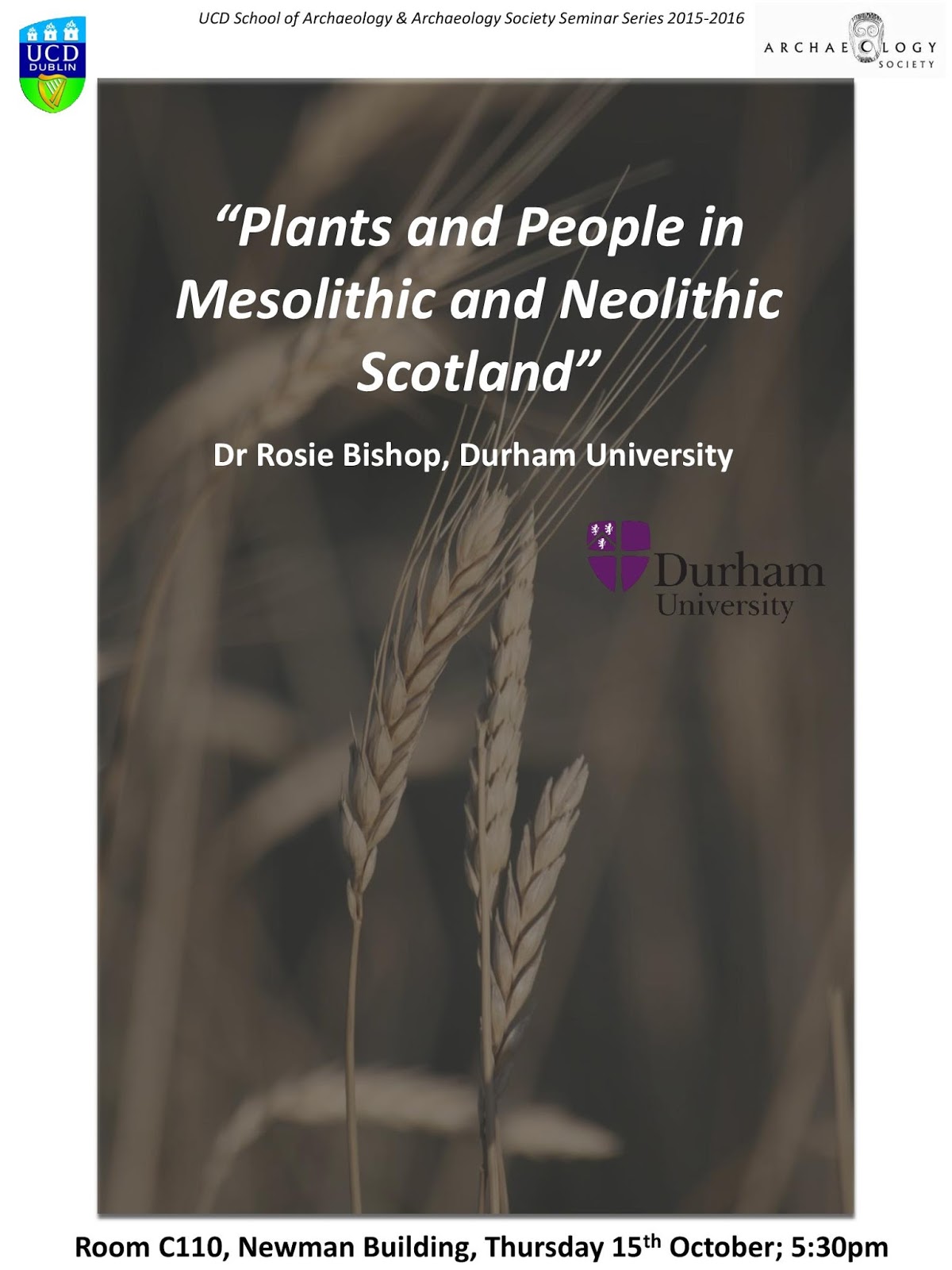
"Plants and people in Mesolithic and Neolithic Scotland"


Seminar by Dr Rosie Bishop, Durham University 


Report by Laura Cawley

This seminar focused on continuity and change in the study of plants and people in Mesolithic and Neolithic Scotland, using archaeobotanical synthesis as a source. Plants are an important source of information in the archaeological record, and can inform us on areas such as past subsistence, for example. Plant remains are the most direct source of information for human plant use, and can show local and regional variation of plant use.
There are a variety of reasons which led to Scotland being chosen for this research. It is the furthest North-Western point in Europe. It was the last area in this region to develop agriculturally. It has a variety of environments, from lowlands and highlands to islands. These are very diverse and challenging environments for the transition to agriculture, and led to variability in agriculture.
The traditional view of these periods is that a hunter-gatherer society was typical of the Mesolithic, which spans from circa 8600-4000 cal. BC, while a farming society was typical of the Neolithic, which spans from 4000-2500 cal. BC. It is taken that the transition between these two periods was an abrupt period of change during the early Neolithic.

This view is increasingly challenged due to evidence of Mesolithic fire ecology, pruning and the management of crops and plants to benefit society. This was done for reasons such as attracting wildlife and to encourage beneficial plants to grow. The management of hazel and oak for food and fuel may have been unintentional or may have been intentional coppicing. The large instance of hazelnut shells at what were most likely seasonal camps may also indicate some large food stores.
Isotopic evidence shows rapid economic change at the start of the Neolithic. At the end of the Mesolithic a marine diet dominated, while at the Neolithic this changed to a terrestrially-based diet. This shows the huge impact farming had on Neolithic society.

Stevens and Fuller believe there was a late Neolithic decline, in which cereal agriculture declined rapidly, and was replaced with pastoralism. They argue that this is due to climatic deterioration. However, there is evidence of an increase in cereal agriculture in the islands surrounding Scotland. It is unlikely that this would happen if it was not also occurring on the mainland.
There was a late Neolithic shift in agriculture, as wheat farming became less common and was replaced by increased barley farming. This was most likely due to the wetter climate which was better suited to barley production. This change was also evident in southern Scandinavia and England. Other crops were also abandoned in favour of those better suited to the wetter climate, which indicates that this change was climatically driven.  However, there are also theories that this was due to a lack of access to certain types of cereals.

In conclusion, there is evidence of the routine and systematic exploitation of plants in the Mesolithic, which is specially shown through hazelnut remains. Cereals were important in the Neolithic, although wild plants were still used. The presence of hazelnut at most sites indicates that plants were routinely and systematically exploited in the Mesolithic. Hazelnut shells may show evidence of large instances of seasonal storage. Sophisticated plant management strategies such as coppicing may have been used. The management of plants played an important role in Mesolithic and Neolithic societies, although more so in the Neolithic, while the reverse is true for the use of wild plants.

Monday, 5 October 2015


“Dublin – Dead Centre of the Viking West?”


Second Seminar by Dr Stephen Harrison from University of Glasgow, given on 1st October 2015


Report by Catríona Baldwin


Was Medieval Dublin the conscience core of the Viking world? This was the question posed to us by Dr. Stephen Harrison on Thursday evening. Following the highly anticipated publication of his project “The Viking Graves Project”, after some fifteen years in the working, Dr. Harrison held the attention of a teeming crowd as he passionately spoke about his project. While informing us of the details of the project, Dr. Harrison also accentuated the variety of hidden issues and problems with the collection and scrutinizing of the materials available for use. Although problems with the antiquarian tradition of recording and preservation data was not unique to Ireland, the Royal Irish Academy’s methods of the documentation of Viking Graves left a lot to be desired. Records of the Viking Grave objects were not only limited but were frequently contradictory, with references being mixed up or not registered at all. For example, a sword unearthed in College Green was given four separate registration numbers. In order to overcome these issues, acquisition groups, based on location and dates, were established and in time were further filtered down to distinguish artefacts from each other within these assemblages. By doing this, it was then applicable to work out the minimum amount of Viking Graves in Ireland, an objective that had never been achievable prior to the project.
The outcome of these acquisition groups was astonishing. From 63 acquisition groups, collectively composed of 401 artefacts, it was arbitrated that there are 107 Viking burials in Ireland. Furthermore, it was also determined that of these 107 burials, three quarters of all furnished Viking graves and four fifths of all Irish Viking grave goods are from Dublin and even more curiously over half of all Irish furnished Viking graves are linked to Kilmainham – Islandbridge. In addition to this, the project enabled the ability to effectively map out the burial complexes in order to further analyse any distinctive patterns. This led to the questioning as to whether or not Dublin was in fact the centre of the Viking Western world.

Fig 1: Viking Burial Sites at Dublin. © National Museum of Ireland. 


In order to answer this question, Dr. Harrison examined the diversity and distributional patterns of Viking burials between Ireland and the insular British Isles. He uncovered that 21% of all Insular Viking graves and 29% of all Viking grave goods found throughout Ireland and Britain, are found in Dublin. This arises the question as to whether or not this is simply caused by a statistical blip and other Viking complexes around Ireland have yet to be located. Dr. Harrison made the compelling argument that due to the scale and extent of these Irish Viking burial complexes that this interpretation simply isn’t plausible and that location of Viking burials is deliberately concentrated in Dublin. In conjunction with this, Dr. Harrison, drawing upon the work of Neil Price, also acknowledged the unconventionally and uniqueness of Irish Viking graves and the rituals that appear to accompany these graves. Not only did Kilmainham-Islandbridge produce the largest number of balances in either Britain or Ireland, but was one of the prime locations where weapons were consciously destroyed beyond any repair.  Predominately in the central zone (Kilmainham-Islandbridge) were weapons deliberately bent, damaged or cremated as part of a carefully controlled ritual. This is perceived to be interconnected with the ideology that weapons, and in particular swords, are symbols of male dominance and power with Viking burials often being furnished with more weapons than one individuals could comfortably carry.
In addition to this, the distinction of Irish Viking weapons from that of the rest of the Viking world further exhibits the uniqueness of Irish Viking Burials. Not only were Irish Viking swords more elaborately decorated than their continental counterparts but other weapons, such as Dublin type Spearheads are found nowhere else in the Viking world. Smaller in size than traditional Scandinavian spearheads, the Dublin Type with its decorated rimmed sockets, was used primarily for throwing rather than for stabbing. Similarly Dublin type shield bosses were equally exclusive to Ireland. Found closely clustered, the shield bosses are believed to have originated from a single workshop, signifying localised metal production in Ireland.


Although male Viking graves are not stereotypical of traditional male Viking burials, female graves do not express this level of local identity and in fact are routinely identical to their eastern equivalent. This has led rise to a number of questions. Were female Viking graves more conservative than male graves, again tying in with this question of male dominance and power, or were the female graves trying to preserve a Scandinavian identity which was otherwise being rapidly assimilated into Irish society?
The question as to if Dublin really was the dead centre of the Viking west still remains a topic for debate. However as Dr. Harrison points out that regardless of the direction in which you approach Dublin you will undoubtfully pass a Viking burial complex. Not only are these complexes mapping out Viking Dublin but are also gallant expressions of a formidable community. We wish Dr. Harrison all the best with his book and further projects and once again thank him for coming and delivering a fascinating talk.


Wednesday, 30 September 2015

"How the Ancient Irish Destroyed Egyptian Civilisation"


First Seminar by Dr Barry Molloy from University College Dublin, given on the 24th September 2015


Report by Laura Cawley

The truth is, the ancient Irish did not destroy Egyptian civilisation. This seminar focused on how extensive the transcultural phenomena were that extended across Europe, and investigated how such phenomena may have originated and spread across Europe. It explored issues such as religious symbolism, focusing mainly from the period 1200-1000 BC.
In the early twentieth century, archaeologists such as Childe used directional diffusionism in archaeological explanation. Ex oriente lux and binary oppositions such as civilisation and barbarianism were used to explain archaeological cultures.

Today archaeologists have very different opinions on what Bronze Age life in Europe and the Mediterranean was like. Harding believes it was a period of local traditions with selective interconnections, while Kristiansen sees it as the ‘EU without the Red Tape’.
There is certainly evidence of cross-cultural links in this period, such as in the area of religious symbolism. One example of this is the sun wheel, which is a prominent feature of European prehistory. This symbol has been found in areas such as Ireland, Turkey, Sweden, Egypt, and many others. Sun symbolism was an integral feature of the period, with examples ranging from Early to Middle Bronze Age gold sun discs to sun symbolism evident on the base of Early Bronze Age pots in Atlantic Europe. It has also been found in the chariot wheels of the Indo-Europeans in the late third or early second millennium BC. Perhaps the most famous chariot which bears this symbol is the Trondheim chariot. This symbolism is evident in many other forms as well, including rock art, jewellery, shields, bridles, leg armour and helmets.

Shields in the Bronze Age world are another medium through which transcultural phenomena are evident. Examples from Iberia and North Western Europe were of similar v-notch forms, both from early dates. Those from Delphi in Greece and Clonbrin in Ireland are also of a v-notch form, as are examples from Denmark and the Czech Republic. There is evidence to support the development of such shields in Atlantic Europe, and their subsequent spread to central Europe.
Spearheads are another medium through which transcultural phenomena can be seen. Spearheads of a typology similar to Bronze Age European examples were found in Mycenaean Europe. These were copies of Bronze Age spears and were not functional, but show the importance of the symbolism of the Bronze Age, as it was still evident four hundred years later. This symbolism played an active role in identity religion.

Apollo was a key figure in Bronze Age religion, and is seen as a voyager between archaeological worlds. He is the only Olympian deity not mentioned in Linear B, and is sometimes confused with Helios. He is the only god whose worship place (Delphi) closed for a month each year. Apollo was introduced from beyond the Mycenaean world after its collapse. Common attributes and derivations of deities are widely shared in Bronze Age religion, as is evident from Apollo.
Bronze Age society collapsed in the Eastern Mediterranean circa 1200 BC. This was due to the invasion of the Sea Peoples. Representations of the boats of these peoples at Medinet Habu seem to indicate boats of Aegean or Danubian style. They may have been a European type, or a derivative thereof. Representations of boats found in Greece, Central Europe and Sweden show similar boats. This indicates a spread of people and ideas.

In conclusion, the Irish did not destroy Egyptian civilisation but the study of the transcultural phenomena across Bronze Age Europe and the Mediterranean have revealed clear linkages between the civilisations of these areas. Studying this with the balance between technology, ideology, and physical mobility kept in mind allows these phenomena to be more clearly seen. Morphometric or taxonomic approaches need a more central role in this study, as well as the up to now dominant typo-chronological approaches. Such study has revealed increased prosperity in Europe and the collapse of the Mediterranean at a time when long-established relationships were more visible. However, unknown parties did assassinate Ramses III by cutting his throat in the mid-twelfth century, leading to the fall of Egypt soon after…

Thursday, 2 July 2015

Etruscan Tombs, Tuscany, Italy


Tuscany, Italy


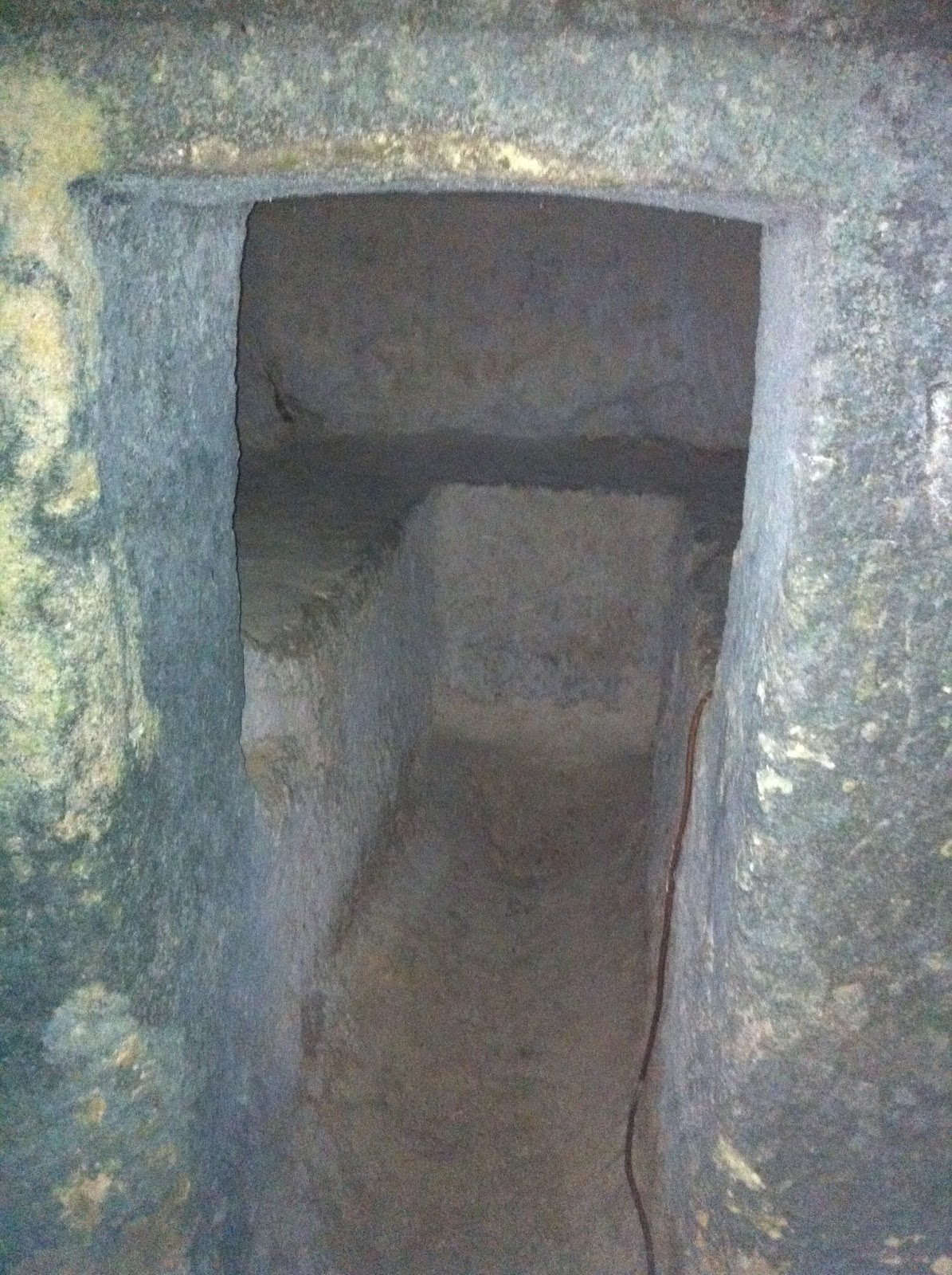
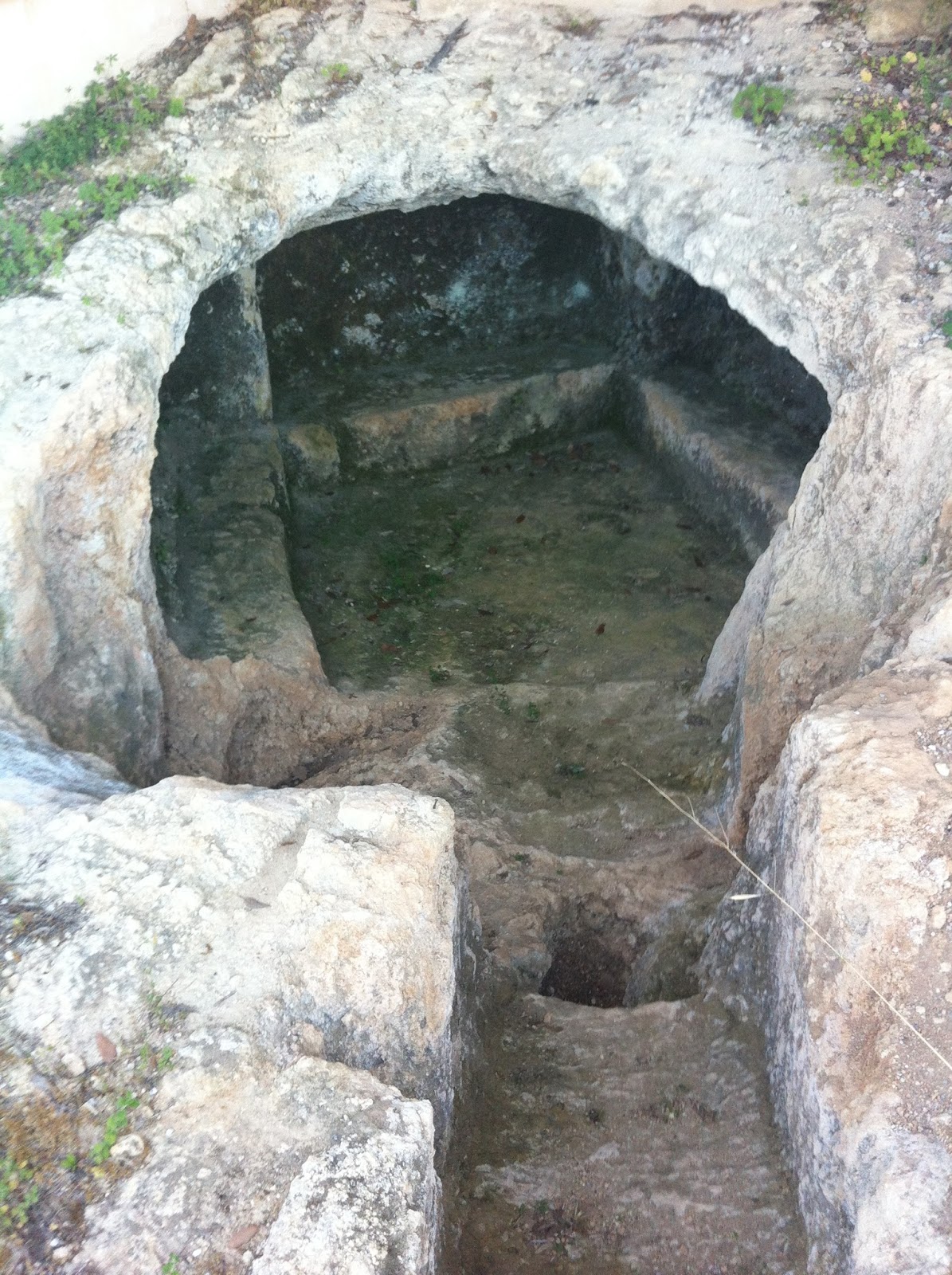
Here are some beautiful shots taken by our third year student Paul MacNamara during his visit to Tuscany, Italy. These photos are of Etruscan tombs, the Etruscans were a society prevalent in north-central Italy by the 8th Century BC. The Etruscan settlement pictured in these photographs was called Dometaia, just outside of the village of Colle di Val d'Else, on the way to Volteria. 
One tomb had an entrance hall and six rooms, with a shelf for the ossuaries. The other tomb was circular.


Below six photographs of rectangular tomb with six rooms


Below six photographs of circular tomb


Below three photographs of amphitheater in Volteria


Two more photographs:


single tomb/grave
graffiti from burial 


Thank you to Paul MacNamara for sharing these photographs and giving us an insight into the archaeology of Tuscany, Italy!